Community-Based Natural Resource Management
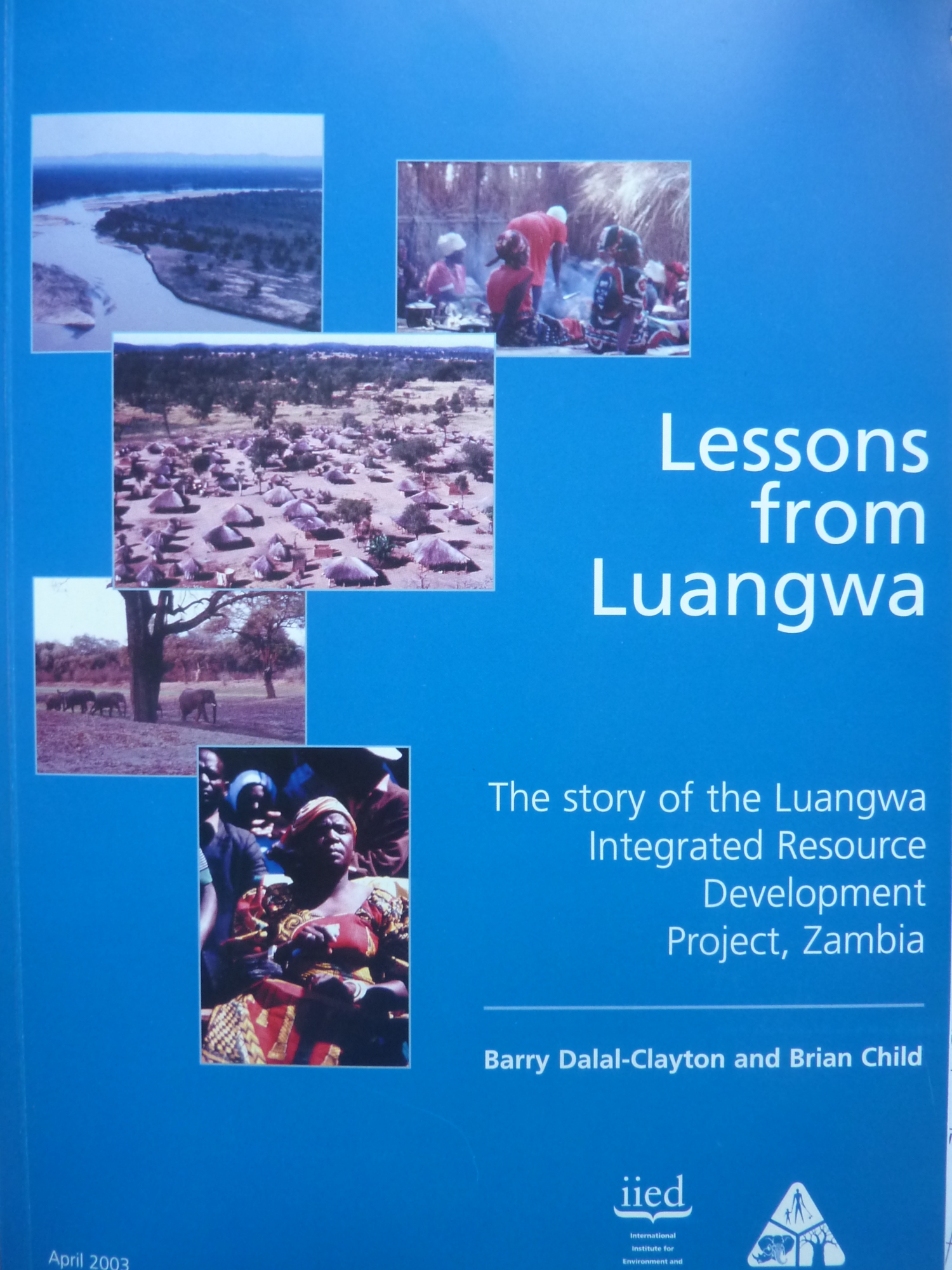
Barry Dalal-Clayton has worked on approaches to community-based natural resource management (CBNRM) for 30 years. In the early 1980s, he was involved in elaborating the concept and early experimentation on CBNRM in Zambia where he was involved in designing and launching the pioneering Luangwa Integrated Development Project (LIRDP) spearheaded by former President Kenneth Kaunda. Funded by NORAD, this ground-breaking initiative was one of the world's first operational CBNRM projects and provided many lessons for the future evolution of CBNRM, particularly in southern Africa. The story of LIRDP is told in "Lessons from Luangwa", a book that Professor Dalal-Clayton co-authored with Brian Child.
 BrIefing President Kaunda on LIRDP in 1984
Later, at IIED, he coordinated a global evaluation of community approaches to wildlife management for DFID (producing the “Whose Eden” report, 1994) which provided the technical basis for an international conference at Sunningdale (hosted by DFID) and established consensus on principles of good practice.

Subsequently, Professor Dalal-Clayton established the “Evaluating Eden” programme - an international initiative with collaborating institutions in several continents, evaluating approaches to community wildlife management and their environmental, social and economic impacts (1996-1997).
Other work in this field have included:
-
Design of technical support initiative to review and revise Nepal’s Protected Areas Policy/Act. Involves comparative reviews of different PAs, their management regimes (including CBNRM approaches), impacts (environmental, social, economic), benefits/disbenefits delivered, and examining management options related to new challenges (eg climate change) (2012)
-
Design of initiative to study the management of protected areas in iconic mountain regions in the tropics to maximize flows of ecosystem services for poor people. With Cambridge University (2012).
-
Facilitated ESPA workshop on ecosystem services and poverty alleviation in the savannah protected areas and rangelands of East and Southern Africa, Arusha, December 2010. Organised by Department of Geography, University of Cambridge, UK, and Southern African Centre for Infectious Disease Surveillance (SACIDS at Sokoine University of Agriculture (SUA), Tanzania
-
Led comparative evaluation of two DFID-funded participatory biodiversity conservation projects in Brazil and Indonesia (1998).